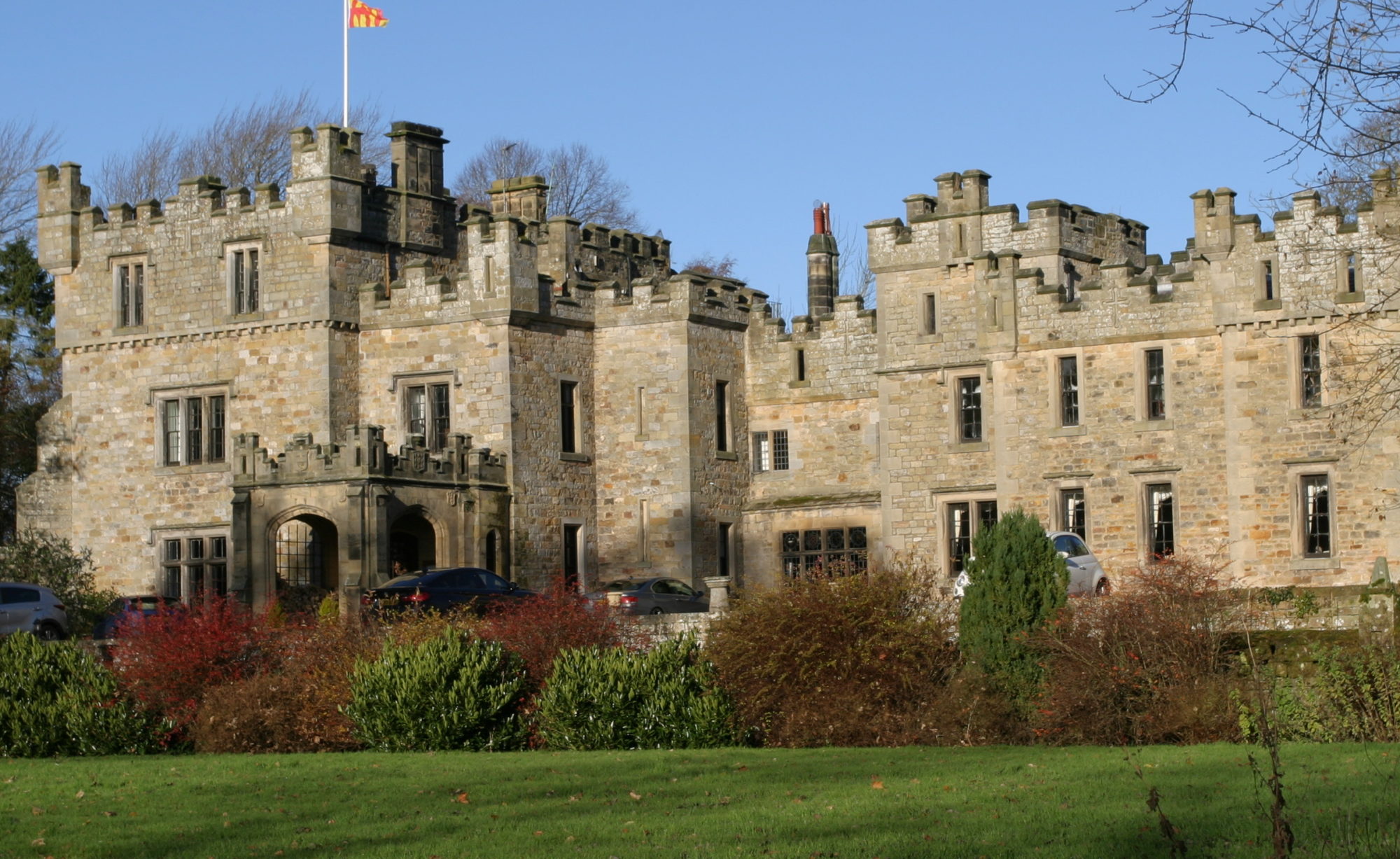

The forty-third annual conference of the Otterburn Society was held in Salisbury, where members once again had the opportunity to present their latest papers on engineering, history, science and an astonishing variety of other subjects.
The lively discussion that follows each presentation is every bit as important as the papers themselves and has become one of the defining traditions of the Society since its foundation in 1982.
Around this year’s conference an excellent programme had been arranged, combining military aviation, medieval architecture, military engineering and the history of Shaftesbury.
Pre Conference Activities
Members gathered on the Thursday evening at the Grosvenor Arms, Shaftesbury, where old friendships were renewed over refreshments before preparations were made for an ambitious programme the following morning.

Friday began at the Boscombe Down Aviation Collection, where Treasurer Firth welcomed members to one of Britain’s finest collections of military aviation. The museum itself proved exceptional, but it was the enthusiasm and encyclopaedic knowledge of the volunteer guides that elevated the visit into one of the highlights of the conference.

Every aircraft, cockpit and engine came with its own story, often told by those who had worked alongside the aircraft themselves. So engaging were the guides that many members reluctantly agreed that considerably more time could happily have been spent there. Unfortunately, Otterburn conferences have never been renowned for generous margins in their timetable and, with military precision, the party moved on to Salisbury, and the magnificent Cathedral.

The contrast between military aviation and medieval architecture could hardly have been greater. Bathed in bright winter sunshine, Salisbury Cathedral was magnificent, the light streaming through the stained-glass windows and filling the great nave with colour. The Society was once again fortunate to benefit from outstanding guides, whose explanations revealed not only the history of the building but also the remarkable engineering behind it.

One feature that particularly captured the Society’s attention was the magnificent medieval font, carved from a single block of Purbeck marble. Although simple in appearance, it has served generations of worshippers for more than seven centuries and remains one of the cathedral’s finest examples of early English craftsmanship. The guides explained the significance of baptism within the life of the cathedral and the symbolism embodied in the font’s elegant proportions. Standing beneath the soaring nave, with sunlight illuminating the ancient stonework, members could not help but admire the skill of the medieval craftsmen who created an object that remains both beautiful and functional after hundreds of years of continuous use.
Members were also fascinated by the cathedral’s medieval clock, believed to be the oldest working mechanical clock in Britain, whilst equal admiration was reserved for the extraordinary foundations. That such a vast structure should stand securely upon little more than gravel, sand and water remains one of the outstanding achievements of medieval engineering. The combination of architectural beauty and technical ingenuity made a lasting impression upon everyone present.

Following lunch at The Rifleman’s, attention returned once more to engineering with a visit to The Tank Museum, Bovington. Housing one of the world’s finest collections of armoured fighting vehicles, the museum charts the development of the tank from its earliest appearance on the battlefields of the First World War through to the sophisticated machines of the present day. Members particularly appreciated the opportunity to examine so many historic vehicles at close quarters. There was, however, one small criticism. Mr Flack observed that whilst the collection itself was splendid, live demonstrations would have provided the opportunity to appreciate these remarkable machines in the environment for which they were designed.
Chairman’s Reception

The Treasurer’s hosted the customary drinks party at his residence and members travelled on to a local meeting place to enjoy dinner and further refreshments. As ever, discussion ranged effortlessly between engineering, history and current affairs, with several members quietly refining their presentations after returning to their hotels.
Discovering Shaftsbury
Saturday morning provided an opportunity to explore Shaftesbury itself. Members first visited Gold Hill Museum before making the obligatory descent, and ascent, of the famous Gold Hill. Instantly recognisable from the celebrated Hovis advertisement, the cobbled street remains one of England’s most iconic views, although several members concluded that it appeared considerably steeper in reality than on television.
The Society then visited Shaftesbury Abbey, where a particularly warm welcome was received despite steadily worsening weather. Once one of England’s richest Benedictine nunneries, the abbey provided a fascinating insight into the remarkable women who directed one of medieval England’s most influential religious houses. Once again, the enthusiasm of the volunteer guides brought history vividly to life and demonstrated the enormous contribution they make to preserving our national heritage.
Lunch at The Mitre was especially welcome after the morning’s rain. Excellent soup and sandwiches, accompanied by warming mulled cider, restored spirits before members returned to the Grosvenor Arms for their Otterburn conference.
The 43rd Conference of the Otterburn Society
You can read the conference agenda here.
The conference was chaired by A D Moore on behalf of Dr Cooper.
As always, the standard of presentations was exceptionally high, demonstrating both the remarkable breadth of interests represented within the Society and the considerable effort invested by members in researching and preparing their subjects. The discussions that followed each presentation proved every bit as enjoyable as the papers themselves.
Presentations

Karl Bëattie opened proceedings in suitably theatrical fashion with an account of attending a truly marvellous party, delivered unmistakably in the style of Noël Coward. Filled with razor-sharp observations, impossibly eccentric characters and wonderfully understated wit, members were left wondering whether the evening had genuinely taken place or whether Karl’s imagination had once again overtaken reality.
Either way, it proved that some stories are indeed far too entertaining ever to appear in one’s memoirs.

John Beck shared a deeply personal account of a visit to Credo Station during a holiday in Australia. Set amid the vast and timeless landscape of the outback, the experience proved to be far more than simply another destination on his itinerary. He described a profound sense of peace and perspective inspired by the station’s simplicity, remoteness and quiet beauty, where the scale of the landscape and the enduring rhythm of rural life encouraged reflection. His thoughtful presentation reminded members that some journeys leave their greatest mark not because of the miles travelled, but because of the lasting impression they make on the traveller.

Jeremy Featherstone provided an engaging introduction to the art of black and white photography, demonstrating how the absence of colour places far greater emphasis upon composition, light and texture. Through a carefully chosen selection of his own photographs, he illustrated how the interplay of light and shadow can create depth, drama and atmosphere, whilst strong contrast helps to define both form and mood. Particular emphasis was placed upon the importance of selecting a compelling subject and arranging the composition to draw the viewer’s eye naturally through the image. Jeremy showed that successful monochrome photography is far more than simply removing colour, it requires the photographer to think differently about tone, balance and visual storytelling. His superb collection of images demonstrated both technical excellence and an artistic eye.

Basil Firth then presented the latest developments in vibratory roller systems, explaining the engineering principles behind their design before producing what was undoubtedly the afternoon’s most memorable demonstration. Assisted by Jeremy, Basil unveiled a working scale model that vividly illustrated how varying vibration frequencies influence roller performance. Complex engineering principles were transformed into an entertaining and highly practical demonstration, prompting lively discussion long after the presentation had concluded.

Mr Flack explored Porsche’s recently patented six-stroke internal combustion engine, a fascinating concept demonstrating that innovation within the internal combustion engine is far from exhausted. By introducing a second compression and power stroke within each operating cycle, Porsche’s design promises improvements in both efficiency and performance through an ingenious crankshaft arrangement. Randall guided members through the engineering with characteristic clarity, whilst ensuring that the inevitable jokes concerning “multiple strokes” remained, for the most part, under reasonable control.

Andy Jordan somehow again achieved what many had thought impossible by transforming European milk quotas into one of the afternoon’s most entertaining presentations. Examining the history, economics and unintended consequences of the quota system, whilst allowing artificial intelligence to retell parts of the story in its own distinctive manner, Andy demonstrated that agricultural policy can be every bit as engaging as mechanical engineering when presented with sufficient enthusiasm.

Alan Moore then turned the Society’s attention towards Mercedes-Benz sports cars and the enduring reputation of German engineering. Tracing the development of the marque from elegant grand tourers to modern high-performance machines, Alan illustrated how innovation, precision and restrained styling have combined to establish Mercedes-Benz as one of the world’s most respected manufacturers. The ensuing discussion inevitably turned to whether German engineering genuinely deserves its formidable reputation, although few departed unconvinced.

Alastair Scarborough concluded the conference with an entertaining account of restoring S/Y Hera before venturing into the Solent, only to discover one of Portsmouth Harbour’s submerged defensive barriers rather more intimately than intended. Charts indicated there should have been ample water over the obstruction, yet the yacht’s keel found the barrier with remarkable precision, bringing progress to an abrupt halt. Despite every effort to free the vessel, the situation eventually required an SOS, and members were pleased to learn that the Royal National Lifeboat Institution responded promptly, towing both yacht and crew safely back to harbour. The experience provided a vivid reminder that even the most careful planning occasionally loses an argument with reality. Read a full report of this incident here.
Following the presentations, members dressed for Dinner before assembling for another excellent evening of food, wine and conversation.
43rd Annual General Meeting
The Annual General Meeting followed, during which the Society’s business was conducted with its customary efficiency and good humour.
The Treasurer reported that the Society remained in sound financial health and thanked those members whose continued support and generosity continue to make the annual conference possible.
The Secretary, however, was obliged to confess that the Otterburn Journal had once again failed to appear during the preceding year. It was not for want of material, indeed, members had been unusually productive in designing new engineering devices, restoring classic vehicles, travelling widely and researching an eclectic range of subjects, but rather through the competing demands of work, family life and the many other commitments that inevitably accompany modern life. Members accepted that the Journal had been postponed rather than abandoned and looked forward to a particularly substantial edition incorporating the papers and photographs from recent conferences.
The election of officers.
Members recorded their sincere thanks to Dr Mark Cooper, Basil Firth and Jeremy Featherstone for their dedicated service as Chairman, Treasurer and Secretary respectively, during the year.
The meeting then unanimously elected Jeremy Featherstone as Secretary, Alastair Scarborough as Treasurer and Basil Firth as Chairman for the forthcoming year. The change marked the beginning of a new chapter in the Society’s history whilst ensuring that its affairs remained in experienced and capable hands.
Roast Beef Sandwhiches

No account of an Otterburn conference would be complete without mention of the traditional midnight sandwiches. For many years members have looked forward to the appearance of the customary roast beef, sustaining debate long into the evening. This year, however, tradition received a distinctly Wiltshire interpretation. At the appointed hour JCB entered triumphantly bearing an entire Wiltshire ham, accompanied by fresh soft rolls and a generous supply of mustard. The opportunity for members to carve generous portions for themselves proved an immediate success, and what began as a welcome variation on tradition quickly became a feast in its own right. Conversation, fuelled by excellent food, engineering debate and perhaps one final glass of Guinness, continued well into the early hours.
Summary
Looking back, Otterburn XLIII perfectly demonstrated everything that has sustained the Society for more than four decades. The conference combined intellectual curiosity with practical engineering, history with humour, and serious scholarship with enduring friendship. Whether discussing medieval cathedral foundations, six-stroke engines, vibratory rollers, milk quotas or submerged harbour defences, members once again demonstrated that no subject lies beyond the scope of an Otterburn conference.
As the last of the Wiltshire ham finally disappeared and members departed on Sunday morning, plans were already beginning for Otterburn XLIV.